From one product to your full catalogue
Publish digital product passports and digital labels behind one QR code, with the sector data, evidence and recall controls your compliance team needs.
Compliance packs per sector
Field sets with help text and required fields for food, wine, cosmetics, feed, batteries and more. Nothing goes live until you review and publish it.
One code, three views
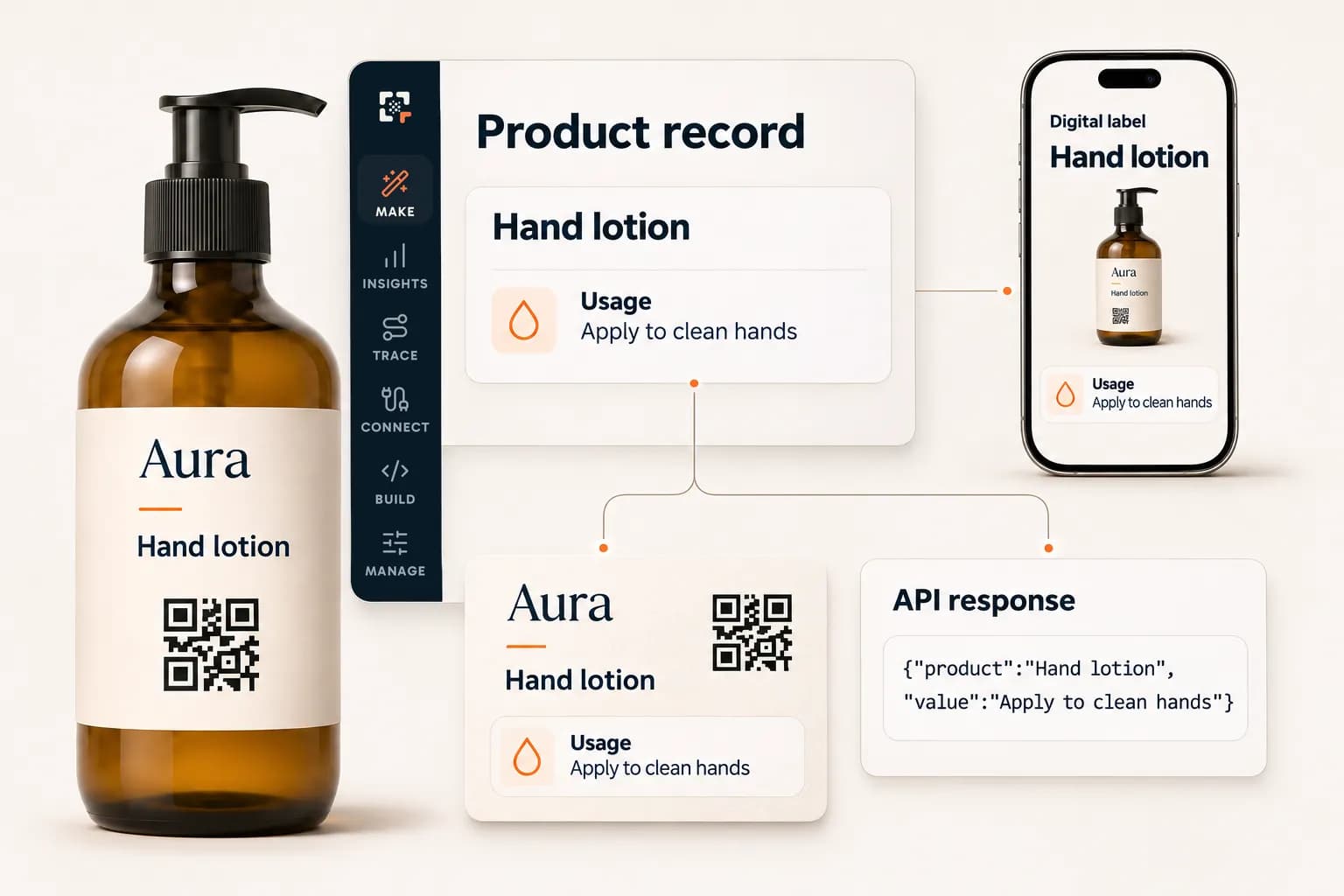
The Label shows what shoppers need at the shelf, the Experience view tells your brand story and the Passport view holds the structured passport data.
GS1 Digital Link-compatible codes
QR codes and short links that open a label page for people and return JSON-LD for machines, at the same URL.
Evidence and recalls
Keep certificates, test reports and declarations with the product. Start a recall and every affected passport shows a warning.
REST API
Create and update products from your own systems with API keys and an OpenAPI specification.
ERP / PIM connectors and single sign-on
Connectors for systems such as SAP and Akeneo, and SAML single sign-on for your staff.
Who this is for
You are a brand or a manufacturer and you place products on the EU market. You need to publish product data in a form that lasts: a digital label with ingredients and allergens, a wine e-label, a battery passport, or the passports ESPR will require for more product groups.
You may start with one product or with a catalogue of thousands. QRabl works the same way for both.
The problem
Your product data is spread across spreadsheets, ERP and PIM systems and supplier PDFs. Regulators, retailers, repairers and recyclers want it in a structured form, at a stable address printed on the product, in their language, for years.
Building that yourself means a resolver for the codes, a data model per sector, translations, hosting, access control and a place for evidence. It also means keeping all of it running after the project team has moved on. QRabl gives you that as a service.
What you can do with QRabl
Start small, grow to the full catalogue
Create products and product models, add your own custom fields, or start from the templates library. When you are ready for more, import products from CSV or Excel files instead of typing them in.
Smaller brands choose a self-service plan and pay by card. Larger brands usually start with a sales-led pilot on a first set of products, then roll out. Plans and list prices are on Pricing.
Sector packs and passports
Compliance packs give you the right fields for your sector, with help text and required fields. Packs exist for food, wine, cosmetics, feed, batteries and more. Food, wine, cosmetics and feed packs cover labelling rules for those products; they are not ESPR passports. The battery pack covers the passport under the Battery Regulation (EU) 2023/1542.
Each passport goes through a review step before you publish it.
For batteries, our paid Battery DPP pilot gets you to a working passport with our team. Full passports for textiles, electronics, construction products, furniture and tyres build on data schemas that exist in the platform. See the industry pages for each sector.
A consumer experience behind the same code
One QR code leads to three views. The Label shows what shoppers need at the shelf. The Experience view tells your brand story. The Passport view shows the structured passport data. Product data is translated, so shoppers read it in their own language.
You design the digital label in the label editor, style the QR code to suit your packaging, and lay out the printed label in the physical label designer. Scan analytics and consumer campaigns run on the same code.
Codes that keep working
QR codes and short links are GS1 Digital Link-compatible. A phone opens the label page. A system that asks for data at the same URL receives machine-readable JSON-LD. Because the code points to a live page, you can change the data without reprinting the pack.
Further options for codes:
- Your own domain on the codes, with automatic certificates.
- Signed QR codes and serial numbers that a scanner can verify, as a check against counterfeits.
- Batch and serial numbering at scale, with print verification.
Read more about the resolver engine.
Evidence, access and recalls
Store certificates, test reports and declarations with the product in the evidence vault, so the proof is in one place when someone asks for it.
Not every reader should see everything. Staff and handlers enter a PIN to see extra information that the public view leaves out. Separate views for authorities, recyclers and repairers go further than PIN access.
If something goes wrong, start a recall. Every affected product shows a warning on its passport. Ten-year retention with legal holds keeps records available after a product is discontinued. See the compliance vault.
Connect your systems
The REST API uses API keys and comes with an OpenAPI specification, so your developers can create and update products from your own systems. A developer sandbox is available on request after an NDA. See the API documentation.
- Webhooks and ERP / PIM connectors for systems such as SAP and Akeneo, so product changes flow in without a manual export.
- Single sign-on (SAML) for your staff. Sign-in with multi-factor authentication is available.
Hosting and uptime
QRabl is hosted in the EU, on our own servers. Paid plans carry an uptime commitment of 99.5%, and Enterprise carries 99.9%. Read more about security and trust.
How to start
- Book a consultation. Tell us your products, your markets and where your data sits.
- Pick a start. A self-service plan for a few products, or a pilot on a first set of products.
- Import, review, publish. Bring in your catalogue, review each passport, publish it and print the codes.
Would you rather buy through your packaging printer or consultancy? Partners can offer QRabl under their own brand. See Solutions.